The landscape of human-computer interaction is undergoing a seismic shift, moving beyond the familiar confines of screens, keyboards, and touchpads. For decades, our primary mode of communicating with machines has been mediated through these physical interfaces, but a new era is dawning. This evolution promises to dissolve the barriers between our intentions and the digital realm, creating a more intuitive, immersive, and fundamentally human way to connect with technology. The trajectory points toward a future where our thoughts, gestures, and even our sense of touch become the ultimate interface, heralding a profound transformation in how we work, play, and perceive reality itself.
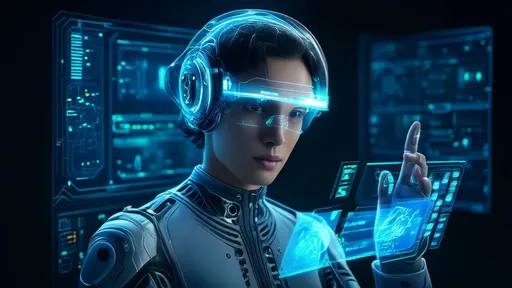
At the forefront of this revolution is brain-computer interface (BCI) technology, a field that once belonged squarely to the realm of science fiction. The core premise is as audacious as it is simple: to translate the electrical symphony of our neural activity into actionable commands for a computer. Early research focused on medical applications, offering hope for individuals with paralysis to regain communication or control over assistive devices. These systems often relied on invasive implants that provided high-fidelity signals directly from the cortex. However, the recent surge in non-invasive technologies, using electroencephalogram (EEG) headsets to read brainwaves through the scalp, is bringing BCI closer to mainstream consciousness.
The potential applications extend far beyond the medical field. Imagine composing an email or navigating a complex 3D model simply by thinking about it. The cognitive load of switching between applications or searching for files could vanish, replaced by a seamless flow of intention-to-action. In creative pursuits, an artist could manipulate digital brushes and palettes with their mind, their imagination rendered on the canvas without the intermediary of a stylus. The very concept of "typing" or "clicking" could become obsolete, replaced by a silent, internal dialogue with our devices. This represents not just an improvement in efficiency, but a redefinition of agency in the digital space.
Yet, the path to a consumer-grade BCI is fraught with immense technical and ethical challenges. The human brain is not a digital processor with clean, easily decipherable output; it is a messy, analog, and profoundly complex organ. Non-invasive methods currently struggle with signal clarity, often requiring extensive user training to calibrate the system to individual neural patterns. The question of data privacy reaches a terrifying new dimension when the data in question is the very content of our thoughts. Robust ethical frameworks and unprecedented levels of cybersecurity will be non-negotiable prerequisites for public adoption. The specter of neuro-surveillance or cognitive manipulation presents a dystopian risk that must be addressed with utmost seriousness.
Running in parallel to the development of BCIs is the refinement of gesture control. While we already have glimpses of this technology in gaming consoles and virtual reality systems, current implementations are often limited and require conscious, exaggerated movements. The next generation of gesture control aims for subtlety and precision, leveraging advanced computer vision, depth-sensing cameras like LiDAR, and AI-powered predictive algorithms. The goal is to understand not just grand sweeps of the arm, but the nuanced language of our hands—a slight pinch of the fingers, a rotation of the wrist, a pointing index finger.
This technology will turn any space into an interactive environment. Your living room wall could transform into a display you control with casual flicks of your hand, scrolling through news feeds or adjusting smart home settings without ever touching a remote. In automotive contexts, drivers could adjust climate controls or navigation systems with intuitive gestures, reducing distraction and keeping their eyes on the road. In industrial or surgical settings, where sterility or precision is paramount, experts could manipulate holographic schematics or control machinery from a distance, minimizing contamination and error.
The true power of gesture control will be unlocked when it moves beyond simple command recognition and into the realm of emotional and contextual awareness. Future systems might detect micro-gestures that indicate frustration or confusion, allowing an interface to adapt and offer help proactively. The combination of gesture and BCI could be particularly powerful, where a thought selects a digital object and a gesture manipulates it, creating a hybrid interaction model that leverages the strengths of both.
Perhaps the most visceral and overlooked component of the future interface is haptic feedback. For all the visual and auditory immersion offered by modern VR, the experience remains hauntingly incorporeal. You can see a virtual brick wall, but you cannot feel it. True presence in a digital environment requires the sense of touch. The next frontier is not just vibrating controllers, but full-body haptic suits and advanced force-feedback systems that simulate the full spectrum of tactile sensation—texture, pressure, temperature, and even impact.
Researchers are exploring various methods to achieve this, from using arrays of precise actuators and vibrotactile motors on the skin to more exotic techniques like ultrasound-focused pressure waves that create the illusion of touching a solid object in mid-air. These technologies will be transformative for telepresence, allowing a surgeon miles away to feel the resistance of tissue during a remote procedure or enabling a loved one to share a virtual hug that carries the weight and warmth of the real thing. In gaming and entertainment, it will elevate immersion to unprecedented levels, making every virtual interaction tangibly real.
The ultimate goal is a closed-loop system where these three paradigms—BCI, gesture control, and haptic feedback—cease to be separate technologies and instead fuse into a single, cohesive interaction language. Your brain issues a command, your gesture refines it, and the environment responds with perfect tactile confirmation. This synergy will be essential for the metaverse or any persistent digital reality to feel genuinely authentic and engaging. It will blur the line between executing a command and experiencing an outcome, making the digital world feel as immediate and responsive as the physical one.
As we stand on the brink of this new era, it is clear that the future of interface is not about a single gadget or a specific input method. It is about integration, biomimicry, and a deeper alignment with human biology and psychology. The transition will be gradual, likely evolving from specialized professional and entertainment applications before trickling into everyday consumer technology. The challenges, particularly around the ethics of BCIs and the practicalities of mass-producing high-fidelity haptics, are monumental. However, the direction is set. We are moving towards a world where technology understands us better than we understand it, responding not to our clicks, but to our will, our movements, and our touch, finally closing the loop between human intention and digital manifestation.
By /Aug 26, 2025
By /Aug 26, 2025
By /Aug 26, 2025

By /Aug 26, 2025

By /Aug 26, 2025
By /Aug 26, 2025

By /Aug 26, 2025

By /Aug 26, 2025
By /Aug 26, 2025
By /Aug 26, 2025
By /Aug 26, 2025

By /Aug 26, 2025

By /Aug 26, 2025

By /Aug 26, 2025

By /Aug 26, 2025
By /Aug 26, 2025
By /Aug 26, 2025

By /Aug 26, 2025
By /Aug 26, 2025

By /Aug 26, 2025
